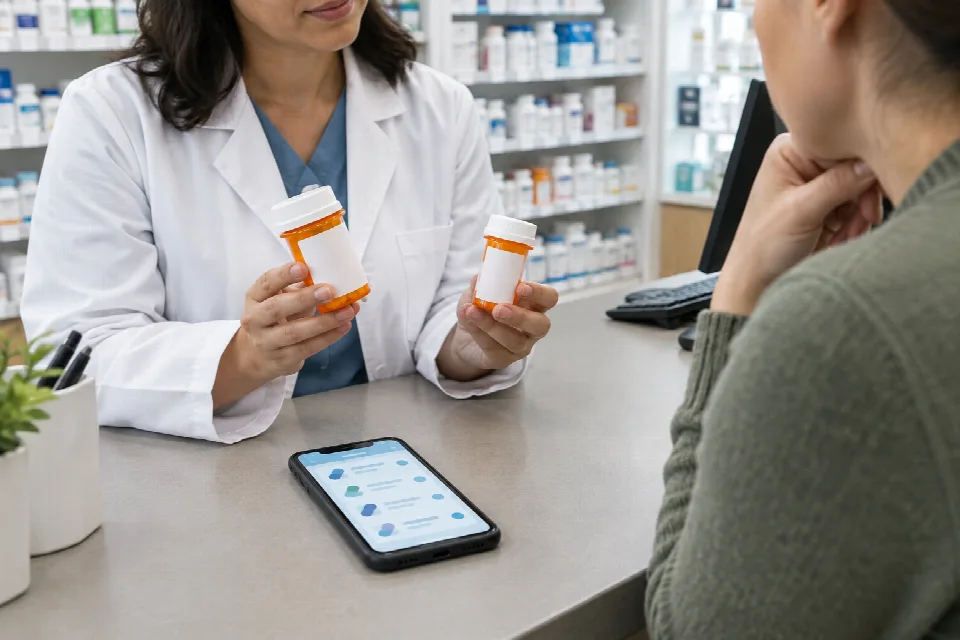
Prescription costs can be an important part of a household budget, especially when someone takes medication regularly. Before filling a prescription, it can be useful to discuss the medication with a health professional and check what different payment options would cost. This guide offers questions to help you explore those options; your prescriber or pharmacist can help you make decisions about your medication.
Why compare prescription costs?
Prices can vary between pharmacies, and a cash price or coupon may sometimes cost less than an insurance copay. Comparing the amount you would pay under each option can give you a clearer picture before you fill or refill a prescription. Check the current price directly with the pharmacy before you make your decision.
You can make the process manageable by focusing first on prescriptions you fill regularly or those that are difficult to fit into your budget. Keep the medication name, strength, dosage form and quantity handy so you can ask each pharmacy about the same prescription.
Understanding generics and discussing options with your prescriber or pharmacist
FDA-approved generics have the same active ingredients, strength and dosage form as their brand-name equivalents and meet the same safety and effectiveness standards. They typically cost less than brand-name medications.
If cost is a concern, ask your prescriber or pharmacist whether a generic is an option for your prescription. You can also ask your prescriber whether a different medication in the same therapeutic class is appropriate. A therapeutic alternative is a separate question from a generic equivalent, so discuss any proposed change with the professional responsible for your care.
Questions to bring to the conversation include: “Is there a generic available for this prescription?” and “Are there other appropriate options if the cost is difficult for me?” Do not change or stop a medication on your own because of its price; ask a qualified health professional about your options.
How to compare pharmacy prices and coupons
Prescription price-comparison services can show cash prices and coupons at participating pharmacies. To search, enter the medication name, strength, quantity and ZIP code. Check whether you are looking at the brand or generic version and make sure those details match your prescription.
When you find a price that looks promising, contact the pharmacy to confirm the amount and ask how to use any coupon. You might also ask about its regular cash price. Compare those amounts with what your insurance plan says you would pay; a coupon is not automatically the least expensive choice for every prescription.
Before changing pharmacies, ask how the prescription would be transferred and what information the new pharmacy needs. If you have concerns about managing several prescriptions in different places, discuss them with your pharmacist.
Checking insurance coverage and out-of-pocket costs
Your plan’s formulary is a place to check for preferred medication options, which may have lower copays. Ask your insurer or pharmacy what you would pay for your specific medication and quantity, and whether there is a preferred option you can discuss with your prescriber.
When comparing insurance with a cash or coupon price, ask the insurer how each payment would be treated under your plan, including whether it would count toward your deductible or other out-of-pocket requirements. Also ask the pharmacy whether a coupon can be used with your coverage. The answers can help you compare more than the price at the counter.
Exploring mail order and assistance programs
Mail-order pharmacies, including those offered through insurers, are another option to explore for ongoing prescriptions. Some offer larger supplies that may lower the cost per unit. Ask about the total amount you would pay, delivery details and how refills work before choosing this route.
For a brand-name medication without a generic, manufacturer copay cards or patient assistance programs may be worth investigating. Ask the program directly about eligibility, application steps and any conditions, and check with your pharmacist or insurer about how the program would work with your coverage.
A checklist before filling a prescription
- Ask your prescriber or pharmacist whether a generic or another appropriate option is available.
- Confirm the medication name, strength, dosage form and quantity you are comparing.
- Check prices at more than one pharmacy and confirm any quoted coupon price.
- Ask your insurer and pharmacy what you would pay using coverage.
- Ask how a cash or coupon payment would be treated under your insurance plan.
- Explore mail order or assistance programs, if relevant, and verify their terms.
- Confirm the final price and any transfer or refill arrangements before filling.
Prices and program eligibility can change, so verify the details each time you consider a different option. For questions about your treatment, consult your prescriber or pharmacist; for coverage questions, contact your insurer.
Sources
- https://health.usnews.com/wellness/articles/how-to-save-money-on-prescription-medications, health.usnews.com
- https://www.medicalnewstoday.com/articles/how-to-save-money-on-prescriptions, www.medicalnewstoday.com
- https://www.fda.gov/about-fda/center-drug-evaluation-and-research-cder/generic-competition-and-drug-prices, www.fda.gov
- https://accessiblemeds.org/resources/reports/2025-savings-report/, accessiblemeds.org
- https://www.goodrx.com/drugs/savings/how-can-i-get-help-paying-for-my-medications, www.goodrx.com
- https://www.rxless.com/resources/10-proven-ways-to-save-on-prescription-drugs-in-2026, www.rxless.com
- https://www.careroute.ai/blog/lowering-prescription-costs, www.careroute.ai
- https://www.health.harvard.edu/medications-and-treatments/how-to-save-money-on-medication, www.health.harvard.edu
- https://www.goodrx.com/how-goodrx-works, www.goodrx.com
- https://support.goodrx.com/hc/en-us/articles/115005063366-Why-did-the-price-for-my-medication-change, support.goodrx.com
- https://www.fda.gov/drugs/generic-drugs/generic-drugs-questions-answers, www.fda.gov
Savings ideas, once a week
One short email with new tips and guides. No spam, and you can unsubscribe any time.