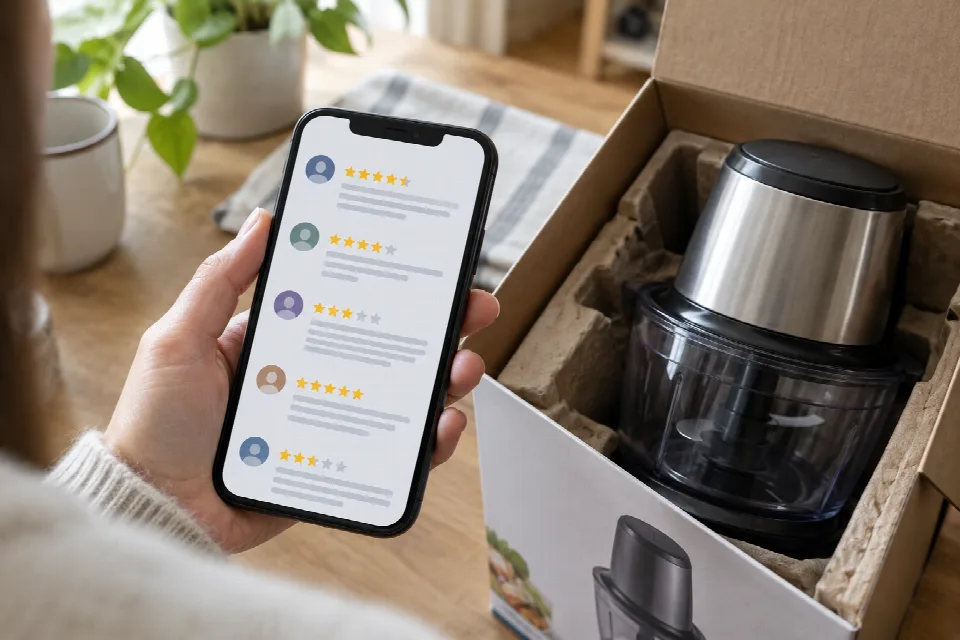
A high star rating can make a product look like an easy choice. But before you spend money on an appliance, a stroller or another household item, it is worth looking at what sits behind the rating.
Fake or misleading reviews can misrepresent customers’ experiences and steer shoppers toward disappointing products. You do not need to investigate every reviewer, but a few checks can help you decide whether the feedback is useful. No single warning sign proves a review is fake; look for patterns instead.
Why review quality matters to your budget
A review is most useful when it helps you judge whether a product will work for your needs. For a family buying a storage unit, that might mean learning whether it fits a small room. For a household appliance, it could mean understanding how easy it is to clean.
A glowing rating alone cannot answer those questions. Misleading reviews can make a poor product seem more dependable than it is, potentially leaving you with something you need to replace. Treat the rating as a starting point, not the whole reason to buy.
How to spot vague or repetitive wording
Read several reviews rather than stopping at the first few. Be cautious if many use generic praise but say little about the product itself, or if multiple reviews repeat similar phrases and sound more like advertising than personal experiences. Those patterns can be warning signs, though a brief or enthusiastic review is not necessarily fake.
Look for details that matter to you: how an item fits into the space available, what assembly was like, or which features the reviewer found useful. A review that explains both a benefit and a drawback may give you more to work with than one that offers only a verdict.
Consider reviews between the highest and lowest ratings as well as the extremes. Ask whether the comments describe a problem that would matter in your home. A drawback for one shopper may not be important to you, while a small inconvenience could be a dealbreaker for someone else.
How to check review dates and reviewer profiles
Sort or scan reviews by date if the site allows it. A cluster of similarly worded reviews posted close together can be a reason to take a closer look. It is not proof of manipulation: timing alone does not tell you why people posted.
If reviewer profiles are visible, open a few. Look at their other reviews and whether you can see a pattern, such as repeated top ratings across unrelated products. A new account, a generic name or a missing photo is not enough on its own to label someone dishonest. Use profile information alongside the wording and timing, and remember that some platforms show little or no history.
What a verified purchase badge can and cannot tell you
A verified purchase badge can be a useful clue that a purchase was recorded, but it is not a guarantee that the review is genuine or unbiased. Check the site’s explanation of its badge, because its requirements may differ from those of another platform. Some deceptive schemes can involve real purchases, so keep reading even when a badge appears.
Likewise, do not automatically dismiss an unverified review. Instead, consider whether it provides relevant detail and whether its points appear elsewhere. If a review discloses an incentive or a connection to the seller, take that context into account too.
How to compare ratings across sources
Search for the same product on more than one retailer’s site and look for independent consumer coverage. Compare the written feedback, not just the average rating. Recurring comments about a feature or problem can give you questions to investigate further.
Make sure you are comparing the same model and version. Then note any differences that matter to the purchase, such as the seller, included accessories and return terms. If the information is unclear or the reviews do not address your main concern, consider waiting until you can check further.
A final check before you buy
Before placing an order, pause and run through these questions:
- Have I read several reviews with specific details relevant to my needs?
- Do the wording, dates or visible profiles show a pattern that deserves a closer look?
- Have I checked what any purchase badge means rather than treating it as a guarantee?
- Have I compared feedback for the same model elsewhere?
- Do I understand the return terms if the item is not right for me?
You may not be able to establish whether every review is real. The aim is to gather enough useful information to make a considered choice—and to feel comfortable leaving the item in your cart if the evidence is not clear.
Sources
- https://www.ftc.gov/news-events/news/press-releases/2024/08/federal-trade-commission-announces-final-rule-banning-fake-reviews-testimonials, www.ftc.gov
- https://www.consumerreports.org/money/customer-reviews-ratings/how-to-spot-fake-online-reviews-a1345282053/, www.consumerreports.org
- https://www.ftc.gov/business-guidance/resources/consumer-reviews-testimonials-rule-questions-answers, www.ftc.gov
- https://www.techtarget.com/news/How-to-spot-a-fake-review-online/872292/, www.techtarget.com
- https://www.pcworld.com/article/2899233/ive-been-burned-by-fake-reviews-online-heres-what-i-look-for-now.html, www.pcworld.com
- https://www.wsj.com/lifestyle/travel/online-travel-reviews-fake-7bbd69ef, www.wsj.com
- https://www.shopify.com/blog/spot-fake-reviews, www.shopify.com
- https://www.bbb.org/scams/spot-a-scam/fake-reviews, www.bbb.org
Savings ideas, once a week
One short email with new tips and guides. No spam, and you can unsubscribe any time.